Can AI write successful public sector bids and, if it can, should it?
Ok, let us set the scene.
I told my AI assistant, which the wife calls Lola but I am not going down that particular rabbit hole, to write me an introduction to this article. It provided the following:
“Artificial intelligence is changing the way organisations work — and bidding for Local Authority contracts is no exception. It can analyse requirements, structure responses, identify themes, generate draft content and refine language at extraordinary speed. Faster. Smarter. More efficient. But winning a public-sector bid is not just about producing polished words — it is about understanding the authority, interpreting what really matters, and turning operational credibility into a compelling case for trust. That isn’t a nice to have. It’s essential.
So the real question is not simply whether AI can write a Local Authority bid — it’s whether it can write a successful one. A bid that is compliant, persuasive and credible. A bid that demonstrates understanding, experience and judgement. A bid that feels written for that authority — not generated for any authority. AI can undoubtedly transform the bidding process — but used badly, it can also make every bidder sound the same. And in a competitive procurement, sounding the same is rarely a winning strategy.”
Notice anything?
Yup. Pretty much all the tell-tale signs of unedited AI-produced content, as outlined in this rather excellent YouTube video.
But what is wrong with it?
Well, as someone who has spent more than 20 years writing, awarding and operating high-profile, high-value, competitively procured public-sector contracts, followed by another, rather successful, 10-plus years reviewing, costing, writing, submitting, winning, implementing and operating them, I think relying on AI to write the whole thing is quite a risky strategy.
And, dare I say it, rather lazy.
Let us be clear. A winning public-sector bid is not simply a data-gathering and writing exercise where AI looks at a question, absorbs a pile of tender documents and produces a response that it thinks answers what has been asked.
Winning these bids is the culmination of understanding an authority, its risks, its priorities, its expectations and the operational reality sitting behind the specification.
Regardless of whether the response is written by AI or by a living, breathing, coffee-and-booze-consuming human bid team, you know the ones, usually occupying a meeting room or a corner of the office covered in Post-it notes while desperately trying to look busy….the bid comes with commitments.
Commitments about how a service will be delivered.
Commitments that requirements will be met.
Commitments that targets will be achieved or exceeded.
It will contain mobilisation plans, milestone dates, staffing models, technology solutions, governance arrangements, social and added value commitments and pricing assumptions.
At least when a human bid team writes it, the poor souls who later have to mobilise and operate the contract have someone to blame when parts of it prove rather more difficult to deliver than the beautifully written tender response suggested.
In short, AI can write wonderfully convincing paragraphs promising the world and everything in it.
It doesn’t have to deliver them.
Now, before you start thinking I am some Luddite, anti-AI dinosaur, I can assure you that I am not.
I use AI every single day.
Sometimes that means searching the internet to find out what happened to Bobby G from Bucks Fizz. Sometimes it means creating images for this very website. Sometimes I give it a draft document and ask it to thoroughly review, challenge and refine it.
Sometimes I even ask it to produce a first draft.
But invariably I then spend a considerable amount of time changing the result so that it sounds more like me and rather less like AI.
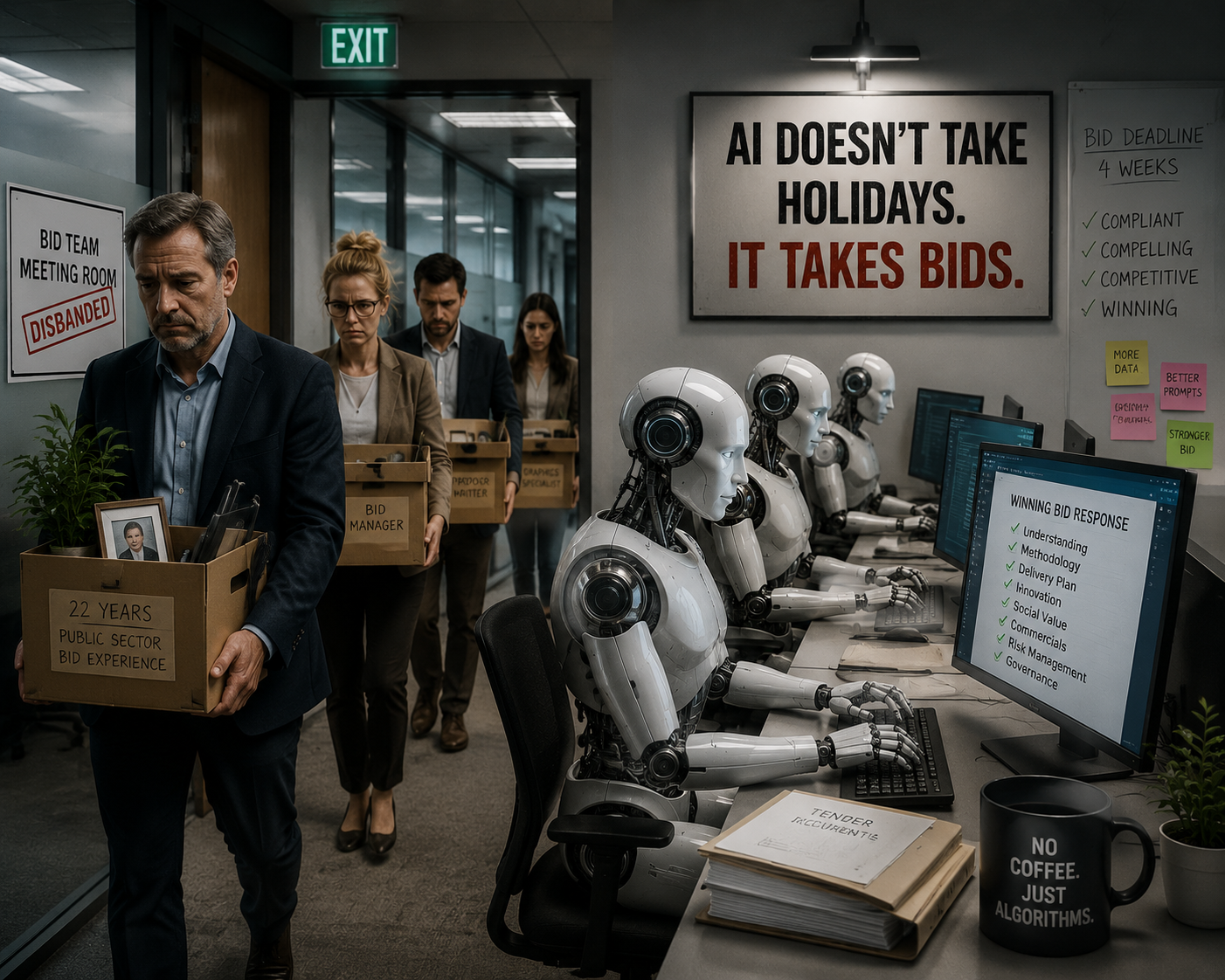
So, as was recently suggested to me, could a business simply give the human bid team the chop, feed the procurement documents into an AI system with a few decent prompts and ask it to respond fully to a major Local Government procurement?
And if it could, could it produce a winning bid?
Right now, I firmly believe the answer is no.
That does not mean some bidders will not try. Nor does it mean that some evaluators will not be impressed by highly polished AI-generated responses and award scores that perhaps would not have been achieved had Trevor the Bid Manager spent six weeks drafting, rewriting, arguing with Operations, chasing Finance, changing the solution and refining the final response through sheer human graft.
It may sound slightly twee, but I firmly believe that winning a public-sector contract deserves more than AI-generated slop. The taxpayer deserves more too.
I have lost count of the number of times I have clicked on what appears to be an interesting YouTube video only to realise, within about 30 seconds, that the entire thing is AI-generated.
For a throwaway YouTube video that may not matter very much.
But if the subject is a service being delivered at taxpayers' expense and the contract has been awarded partly because an AI bot produced a series of killer responses to the evaluation questions, that is quite another matter.
Over the past couple of years, I have also received an alarming number of emails that were clearly 100% AI-generated, without, I suspect, the author taking even a minute to read through the finished result.
Just the other day I received an entire position paper that appeared to have been produced in exactly this way. It was broadly on the right track, but it was factually incorrect in places, far too long and written in the style of C3PO explaining the Quantum Realm to Captain Kirk or some other incomprehensible nerd nonsense.
Such slapdash and poorly considered use of AI can have significant consequences, not just for businesses but potentially for governments and public bodies too.
So, is there a place for AI in UK public procurement?
Of course there is.
I have used AI extensively, as have colleagues, when developing content for tender submissions. It can help create images and tables. It can analyse specifications. It can review draft answers. It can identify gaps in a response or highlight requirements buried elsewhere in the procurement documents that a bidder may have missed.
Tasks that once took considerable time and effort can now be completed much more quickly saving time and money.
But the benefit, in my view, is that it can and should free the humans involved in the bid to spend more time improving, challenging and refining the submission during the often painfully tight timescales in which tender responses have to be completed.
AI can and should be used to help write the bid rather be the primary bid writer.
There is also an important distinction between AI being able to tailor text to an authority and genuinely understanding that authority.
Give AI enough material and it can ingest corporate strategies, procurement documents, policies, annual reports, previous tender material and publicly stated priorities. It can then produce a response that appears remarkably well tailored.
What it cannot replicate is the accumulated understanding that comes from actually engaging with an organisation. You know, that thing we used to do a lot pre 2020, face to face meetings and engagement!
AI does not attend meetings.
AI does not spend time with operational teams.
AI does not see where previous contracts have succeeded or failed.
AI does not pick up the concerns that never quite make it into the specification.
AI does not develop an understanding of what the authority's people regard as genuinely good service.
And it certainly does not build trust.
That comes from long-term, constructive and positive engagement between actual humans over weeks, months and sometimes years.
For businesses serious about winning public-sector work, that knowledge matters.
Understanding the authority, its operational priorities, its concerns, its expectations and its view of what good really looks like is what allows a bidder to move beyond simply answering the question and instead submit a response that is credible, deliverable and relevant.
So should a business looking to win public-sector contracts dispense with its human bid writers and rely entirely upon AI?
Good luck and best wishes if you do.
AI can do a tremendous amount of the heavy lifting. It can make a good bid team faster, better informed and potentially much more effective.
But can it, on its own, write a genuinely winning public-sector bid?
Not yet.
And as my AI assistant would probably put it:
That isn't a reality. It's wishful thinking.